Structure – WP
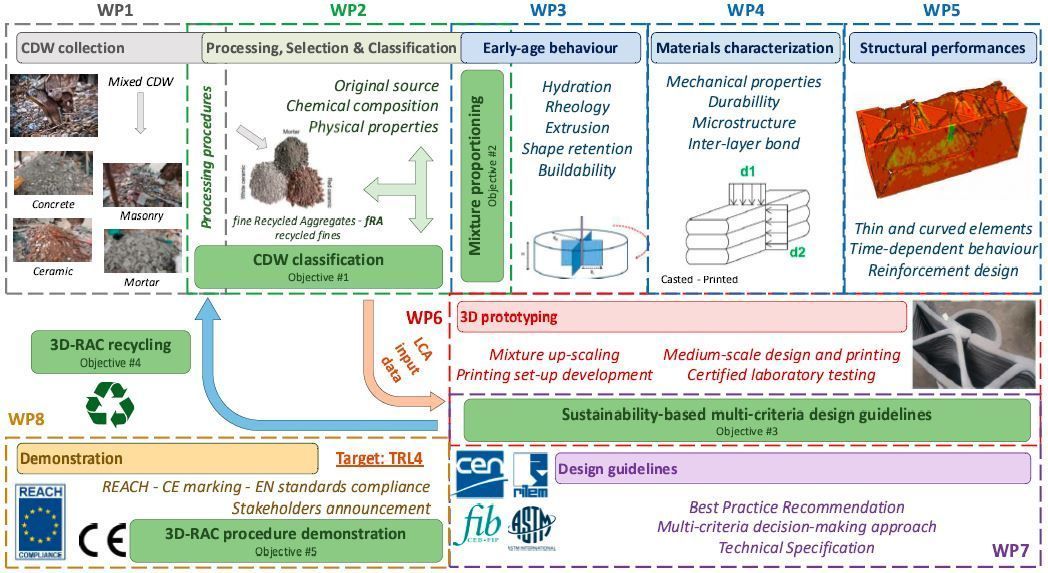
The following scheme summarizes research methodology, approach and logical sequence of Recycl3D. It highlights that the project consists of Applied/Industrial Research activities in the fields of sustainable construction materials & structures and additive manufacturing, structured into 8 research Work Packages (WPs).
WP1 (CDW collection)
Collecting information regarding the production of recycled aggregates from CDW generated in the EU and preliminary characterization of representative fRA.
The work of this WP is organized in two tasks that will be focused on the preparation of a report on (i) recycled aggregate from CDW and (ii) the execution of tests on fRA. This will lead to proposing a comprehensive report on the production and use of fRA from CDW. Experimental physical and geometric tests (i.e., grain size distribution, density and water absorption capacity) will be performed on representative samples of fRA. The samples will be obtained from CDW generated in all project participant Countries and, moreover, different sources (by type of CDW, grading and CDW plants) will be considered.
WP2 (Processing, Selection & Classification)
Optimization of the processing procedure for obtaining suitable fRA to be used in 3D-RAC, systematic analysis of physical, chemical and geometric properties of fRA, proposition of a performance-based classification for fRA, deconstruction, recycling and recovery of end-of-life 3D-RAC.
Moving from a fundamental experimental characterization of fRA, a comprehensive performance-based classification will be proposed. On the other hand, the analysis of the several processing procedures will lead to optimize it in order to obtain suitable fRA for 3D-RAC. Finally, the feasibility of recycling 3D-RAC produced during the activities of WP3 and WP4 will be also evaluated. Fundamental characterization of fRA, performance-based classification for fRA, processing procedure optimization, selection of fRA for 3D-RAC and recycling and recovery at End-of-life 3D-RAC will be carried out in this WP.
WP3 (Early-age behavior)
Formulation of a tailored mixture proportioning method for 3D-RAC, illuminating the influence of fRA particles on the resulting rheology at the fresh state of 3D-RAC and analysis of the primary and secondary hydration of 3D-RAC.
The WP activities are organized in four tasks, (i) mixture proportioning and mixing procedures assessment, (ii) rheology at the fresh state, (iii) hydration and pozzolanic activities and (iv) modelling approach for 3D-RAC in the fresh state, devoted to the analysis of the early-age behavior of 3D-RAC.
WP4 (Materials characterization)
Identifying the influence of fRA amount and typology on the resulting mechanical performance of 3D-RAC in the hardened state, understanding the role of fRA on the durability and long-term behavior of 3D-RAC and analyzing the bond mechanism between the several printed layers. (i) Mechanical properties, (ii) shrinkage and durability indicators, (iii) bond behavior between printed layers, and (iv) modelling approach for 3D-RAC at hardened state tasks are devoted at the analysis of the hardened state performances of 3D-RAC.
WP5 (Structural performance)
Proposition of theorical approaches for the evaluation of the structural performance of thin and curved 3D-RAC elements; determining the influence of setting and hardening processes in 3D-RAC on the resulting time-dependent structural behavior; evaluating the feasibility of using distributed fiber reinforcement in 3D-RAC elements.
The WP is organized in (i) structural analysis of thin and curved 3D-RAC elements, (ii) time-dependent structural 3D-RAC behavior, and (iii) reinforcement design for 3D- RAC elements tasks dedicated to the structural analysis of 3D-RAC elements, considering the various possible shapes and the time evolution of the mechanical properties of the produced mixtures.
WP6 (3D prototyping)
Up-scaling mixtures towards medium-scale printing, development of proper printing set-up and technology, development of protypes, printing and testing.
The WP is organized in (i) test setup for prototyping, (ii) shape and geometry of 3D-RAC prototypes, and (iii) realization and testing tasks related to prototyping of the 3D- RAC and medium-scale testing.
WP7 (Design guidelines)
Preparation of practical design guidelines, formulated in such a way to facilitate future incorporation into design codes.
The WP is organized in (i) Materials and structural technical specification, (ii) environmental and economic based design approach, and (iii) multi-criteria guidelines for sustainable design tasks. Based on the results obtained in the previous WPs, sustainability-based multi-criteria decision-making methods (such as MIVES) will be used to achieve an optimal design using full life cycle thinking and considering all three pillars of sustainability (economic, environmental and social).
WP8 (Demonstration)
First steps towards fRA CE marking demonstrative realization of 3D-RAC elements evaluation of the suitability of prototype towards certification.
The WP is organized in validation of the fRA as a certifiable raw material for concrete production, and industrial demonstration realization tasks. Based on the WP6 prototypes, a set of activities towards preparing a material for industrial use will be performed. In the first stage, selected fRA suitable for 3D printing applications will be compared with the requirements for CE marking. Then, a set of activities towards complying the developed 3D-RAC demonstrator to selected standards will be prepared.